We use cookies where necessary to allow us to understand how people interact with our website and content, so that we can continue to improve our service.
We only ever receive anonymous information, and cannot track you across other websites. View our privacy policy

Today the UK Government overcame one of the largest hurdles standing in the way of its controversial Rwanda Policy by getting its flagship piece of legislation through Parliament. But what is the Rwanda Plan? Why is it so controversial? Why is the Government doing it? How will it work and perhaps more importantly, will it work at all?
Here to answer all your questions is another helpful Best for Britain FAQ.
What is the Rwanda Policy?
The Rwanda Plan was first proposed by Boris Johnson in April 2022 when he was Prime Minister. It is the Government’s plan to send asylum seekers and refugees arriving in the UK to Rwanda without first hearing their case to stay in Britain. Under international law, all nations are required to allow people fleeing severe danger such as war and torture to claim asylum, allowing them to rebuild their lives in the safety of the country in which they do so.
The plan has received broad condemnation for being cruel, unworkable, extremely expensive and likely to prove ineffective.
Why is the Government doing it?
The Government claims that by threatening to send people to Rwanda, they will stop paying people smugglers to help them cross the Channel, something which only started and which has only increased since the Conservative Party came to power. This is because the Government has made it almost impossible for people to safely claim asylum in the UK any other way, including people who have put their lives at risk by fighting alongside British forces in Afghanistan.
What is the Rwanda Bill?
In November 2023, the UK Supreme Court ruled that the Rwanda policy was unlawful because Rwanda was not a safe country to send refugees and asylum seekers. To overcome this, the Government did not seek another partner nation or ways to help make Rwanda safe. Instead, they introduced the Safety of Rwanda (Asylum and Immigration) Bill, a piece of legislation that will permanently designate Rwanda as a safe country under UK law regardless of any facts or evidence to the contrary. It means a war could break out in Rwanda tomorrow and UK judges will still be required to agree that Rwanda is safe. The Bill has been roundly criticised for enshrining a basic denial of fact in law which itself sets a dangerous precedent that could be exploited in future.
What is wrong with the Rwanda Plan?
Experts and campaigners assert that:
- The Rwanda policy won’t offer much deterrent as people are already desperate enough to put their lives and often the lives of their family at risk by undertaking dangerous small boat crossings.
- The relatively small number of people Rwanda has agreed to take means it will also offer little deterrent value. Rwanda has agreed to receive a maximum of 200 people annually, which is just 0.7% of the number of people who arrived in Britain via dangerous Channel crossings in 2023.
- It has badly damaged the UK’s international reputation.
- Rwanda has a poor human rights record and people sent there will be at risk of human rights abuses or being returned to the country they escaped also known as refoulement.
- At a cost of £1.8million per person for the first 300 refugees sent to Rwanda, it is extremely expensive and far more expensive than allowing people to rebuild their lives and pay tax in the UK.
- It sets a dangerous precedent by allowing ministers to remove people en masse in contravention of international and domestic law.
- The Government is contradictorily claiming that Rwanda is both a nice place for refugees to rebuild their lives and horrible enough to offer a deterrent.
- The Government has misled the public about what accommodation is prepared for the people who are sent to Rwanda
- Even if they are found to have a genuine claim, refugees and asylum seekers will not be allowed to return to the UK, but will have to stay in Rwanda.
- Threats from Government figures to erroneously remove the UK from the European Convention on Human Rights (ECHR) to further the Rwanda policy undermines the Good Friday Agreement.
- The best way to reduce dangerous Channel crossings is by restoring safe routes for people to claim asylum in the UK.
Has the Rwanda Bill been passed?
The Rwanda Bill was passed in the early hours on Tuesday 23 April 2024 after a lengthy back-and-forth between the House of Commons and the House of Lords. It will shortly receive royal assent after which it will become the Safety of Rwanda Act.
Which MPs voted against the Rwanda bill?
Sky News has a handy tool which lets you find out how your MP, or any other MP voted on the Safety of Rwanda Bill.
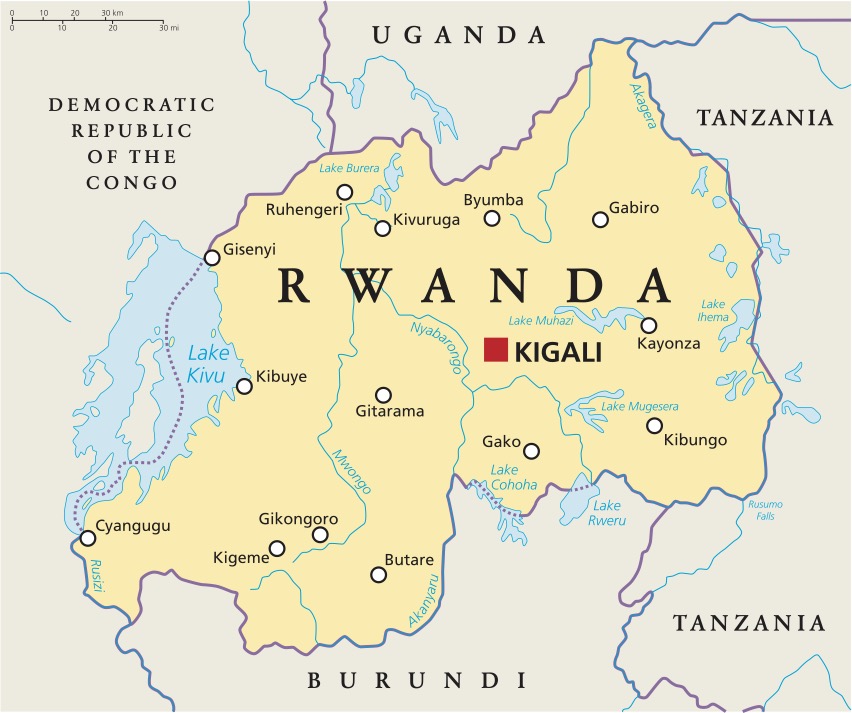
Where is Rwanda?
Rwanda is a landlocked country in east-central Africa. It is neighboured by Uganda, the Republic of Tanzania, Burundi and the Democratic Republic of the Congo.

Is Rwanda safe?
In November 2023, the UK’s Supreme Court unanimously found that the Government’s Rwanda policy breached both international and UK law on the grounds that Rwanda is not a safe third country due to the risk that asylum seekers would face of refoulement.
Refoulement is the forcible removal of refugees or asylum seekers to a country, including their country of origin, where they are likely to be subjected to persecution. Refoulement is prohibited under both UK domestic law and international human rights law.
The Safety of Rwanda Bill does not make Rwanda a safe third country or offer individuals at risk of refoulement and other human rights abuses sufficient protections. It merely defines the country as safe in UK domestic law.
The House of Lords introduced an amendment to The Safety of Rwanda Bill which would mean Rwanda could not be treated as a safe country until an independent monitoring body deemed it so, but the amendment was rejected.
How much has the Rwanda scheme cost?
Since April 2022, the UK Government has paid £220m to Rwanda, with further annual payments of £50m scheduled for the next three years, taking the total to £370m by the end of 2026.
Once the first 300 migrants have been relocated, ministers have agreed to put a further £120m into the fund, upping the total to £490m. On top of this, an extra £20,000 will be paid for every asylum seeker relocated to the African country.
The Home Office will also separately pay around £151,000 per person to cover asylum processing and integration costs over five years if they stay in the country.
Analysis by the Institute for Public Policy Research (IPPR) has found that total costs could reach £3.9bn if every asylum seeker stayed in Rwanda for five years, or if all left straight away, £1.1bn.
This does not include the legal or logistical costs.
Will the Rwanda plan work?
Probably not for all the reasons listed under ‘What’s wrong with the Rwanda Plan?’
Have any refugees been sent to Rwanda yet
No asylum seekers or refugees have yet been sent to Rwanda although the Government claims the first cohort will be sent by June-July 2024.