We use cookies where necessary to allow us to understand how people interact with our website and content, so that we can continue to improve our service.
We only ever receive anonymous information, and cannot track you across other websites. View our privacy policy

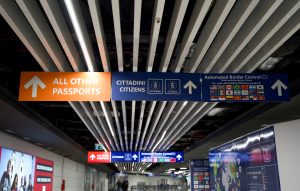
What is the EU’s Entry/Exit System (EES)?
The EES is a new digital border system, which came into full effect in April this year. It monitors the movement of third-country nationals, non-EU and non-European Free Trade Association (EFTA), across the external borders of the Schengen area.
It has changed requirements for British citizens travelling to the Schengen area, and means travellers need to register biometric details (fingerprints and a photo).
What countries does the Entry/Exit System apply to?
EES applies to all countries in the Schengen area. The Schengen area consists of 25 EU countries, Iceland, Norway, Switzerland, and Liechtenstein.
The EU countries that operate in Schengen are:
- Austria
- Belgium
- Bulgaria
- Croatia
- Czech Republic
- Denmark
- Estonia
- Finland
- France
- Germany
- Greece
- Hungary
- Italy
- Latvia
- Lithuania
- Luxembourg
- Malta
- Netherlands
- Poland
- Portugal
- Romania
- Slovakia
- Slovenia
- Spain
- Sweden
As Cyprus is not the Schengen area, British citizens are not required to complete the EES when entering or leaving the country. You can travel without a visa to Cyprus for up to 90 days.
For British citizens travelling to Ireland, the EES will not apply. Journeys from Northern Ireland or Great Britain to the Republic of Ireland are governed by the Common Travel Area which allows you to visit and remain indefinitely.
Why do some countries/airports do EES and others don’t?
Only countries in the Schengen area require EES. The Schengen area refers to a system of open borders that incorporates 29 countries.
The Schengen travel area is home to over 450 million people. Once you have crossed the external border of a country in the Schengen area, then in principle you can travel freely across the borders of all participating countries.
What do I have to do for the Entry/Exit System?
When entering a Schengen country, you may be asked to provide fingerprint scans and have your photo taken.
Additionally, the Entry/Exit System will hold data about your full name, date of birth, the date and place of each entry and exit, and whether you were refused entry.
Do I have to do EES to leave the UK?
No, you do not need to complete EES checks at the airport when you are either leaving or arriving in the UK – EES only applies when arriving at or leaving a country within the Schengen area.
For example, you would not need to complete EES checks at Heathrow if flying to Rome, but you would after you landed in Rome – and vice versa – you would need to complete EES checks when you leave Rome, but not when you land back at Heathrow.
How long will the Entry/Exit System take at the airport?
Queues vary by airport, depending on how the system has been rolled out. For example, where UK nationals have been allowed to use e-gates as well as self-service kiosks, queue times have increased to around 20 minutes.
However, in some cases, EES has tripled the time it takes for Brits to get through passport control, and queues can range from minutes to hours.
Why are passport queues so long?
If you have been away to the Schengen area recently, you may have noticed that passport queues are increasingly lengthy.
This is because the EU has introduced the new checks – and in some places, the additional requirements are causing significant delays for travellers.
How early should I arrive at the airport for my flight home?
You should always check with your airline. For example, Wizz Air is now recommending arriving at the airport three hours before your flight home to the UK.
Why has the Entry/Exit System been introduced?
The Entry/Exit System has been introduced to reduce illegal migration into the Schengen area.
By digitalising the system, it’s easier for EU countries to see if visitors are overstaying the number of days that they are eligible for. Without a visa, British citizens can stay in the Schengen area for a maximum of 90 days within any rolling 180-day period.
How many times will I have to do the Entry/Exit System?
You will have to do the Entry/Exit System every time you cross the external border of the Schengen area. This is not required internally within the Schengen area- for example, travelling between France and Spain. The EES system will monitor the length of your stay in the area and whether you go above the 90 days in 180 rule.
Do I have to do Entry/Exit System checks because of Brexit?
Yes. When we left the EU, British citizens lost our EU citizenship and became third-country nationals. Unless you have dual EU nationality, British citizens have lost freedom of movement rights and can only stay in the EU for a maximum period of 90 out of 180 days.
EU nationals are exempt from having to do Entry/Exit System checks, even if their country is outside the Schengen zone.
If the UK had remained a member of the EU, the checks would not apply to British citizens, even though the UK was never inside the Schengen zone.
Who is holding my biometric data and who will get access to it?
The biometric data will be held in a central EES data system managed by eu-LISA and be accessible to:
- Border, visa, and immigration authorities in the Schengen area,
- Law enforcement in the Schengen area and Europol,
- Potentially transferred to another country under very strict conditions – for example to the UN or domestic law enforcement agencies that have data sharing deals with the EU.
Your data will be held for three years after the record is created.
Will I need to do EES for the Eurostar?
Yes – UK and other non-EU citizens using the Eurostar will need to complete the checks at self-service pre-registration kiosks at London St Pancras and Folkestone.
What are my rights if I miss my flight because of Entry/Exit System delays?
Travellers have no rights if you miss your flight because of the Entry/Exit System. Airlines are not obliged to compensate you in any way nor find you another flight.
Will I still get a stamp in my passport?
No – you will no longer get a stamp on your passport. EES has replaced that process.
If I did the EES on arrival to the EU and overstay my 90 days what happens?
Once it has been established that someone has overstayed the 90-day rule, they will be subject to return procedures – initially given the opportunity to depart voluntarily.
If this happens, this data will be registered on EES, and they might face a ban from entering the Schengen area in the future.