We use cookies where necessary to allow us to understand how people interact with our website and content, so that we can continue to improve our service.
We only ever receive anonymous information, and cannot track you across other websites. View our privacy policy

The second UK-EU Summit has concluded. We are still waiting for the full legal texts from both sides, so this FAQ is based on the Joint Statement and Explainer documents published by the UK and the EU.
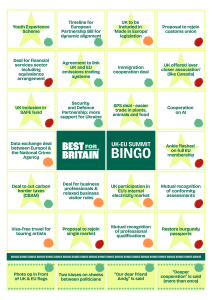
The key outcomes of the summit centred on the heavily trailed Youth Experience Scheme, the linking of the two Emissions Trading Systems and the Sanitary and Phytosanitary Agreement. But what else was agreed? And where is there more work to do?
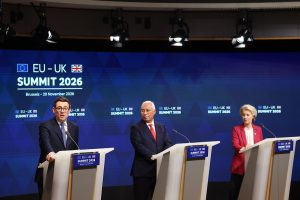
Picture by Simon Dawson / No 10 Downing Street
1. A Youth Experience Scheme
The Youth Experience Scheme, first announced at last year’s summit, has now been agreed. The capped scheme means that 100,000 young people (aged under 31) from the UK can live, work and study in the EU for up to three years, and vice versa.
Places will be allocated between Member States according to their relative population size, for both inbound EU participants and outbound UK participants. Young people in the UK will apply to a particular Member State, such as France or Germany, but will be able to switch to another, living in a maximum of three countries over the three-year period.
The UK Government expects the scheme to begin by January 2030. Participants will not be able to claim benefits in either the UK or the EU. The EU and the UK have also agreed to complete negotiations within six months on a further agreement on tuition fees making it easier for students to study in each other’s territories.
2. An Emissions Trading System agreement
Both the UK and the EU make big polluters pay for each tonne of carbon they emit. At the summit, the UK and the EU agreed to link the two’s carbon markets and Emission Trading Systems, meaning carbon allowances can be traded across both and sparing businesses from paying carbon border taxes twice. This will exempt around £6.5bn worth of UK exports from the EU’s Carbon Border Adjustment Mechanism, making trade cheaper.
UK manufacturers with operations in the EU will benefit from shared rules across both markets, cutting paperwork and compliance costs.
3. SPS Deal
The UK-EU Sanitary and Phytosanitary (SPS) Agreement will dynamically align the UK’s food and drink regulations with the EU’s. This means that British exporters of perishable goods, such as seafood, flowers or meat, will be able to trade more easily with their largest market across the Channel. The agreement will lower the cost of doing business by cutting the red tape and reduce trading costs that both British and EU firms face when exporting their products.
In particular, the agreement will remove the requirement for costly Export Health Certificates and phytosanitary certificates. Beyond the financial benefits, the SPS deal will remove the need for extensive and time-consuming physical checks at the border. Taken as a whole, the deal will give British consumers more choice at the supermarket, lower costs for food producers, easing pressure on food prices, and make it easier for British companies to export their produce to the EU. The UK Government projects the SPS deal could add up to £5.1 billion a year and increase UK GDP by up to 0.14%.
Morrisons, Tesco and M&S were quick to back the new deal, with Alex Freudmann, M&S Managing Director of Food, saying:
“We’ve long championed a UK-EU food trade deal, and today’s announcement is a major step forward. Getting our spaghetti bolognese from Lincolnshire onto a shelf in Dublin takes hundreds of extra miles, mountains of paperwork, a vet’s signature and even the Latin name of a cow.”
4. Pet Passports
As part of the SPS agreement, the UK and the EU agreed to make taking pets on holiday to Europe easier. Rather than needing a new animal health certificate for every trip, pet owners will be able to get a multi-use pet passport. This will lower costs for British travellers and make it simpler to travel to the EU with pets.
5. Security and Defence Partnership for Ukraine
Just before Andy Burnham took to the podium alongside European Commission President Ursula von der Leyen and European Council President António Costa, it emerged that Russian missiles had violated Polish airspace. The incident served as a timely reminder of how important the war in Ukraine has been to rebuilding UK-EU relations.
The UK-EU joint statement issued after the summit reaffirmed both sides’ commitment to Ukraine. It confirmed that the UK would continue to support the training of the Ukrainian Armed Forces, coordinate closely with the Coalition of the Willing and participate in the EU’s Ukraine Support Loan. The UK and the EU also agreed to step up cooperation against hybrid threats from hostile actors and to develop a dialogue on democratic resilience.
6. Cooperation on AI
The UK and the EU also agreed to strengthen cooperation on artificial intelligence, alongside closer coordination on global macroeconomic policy. Both sides recognise what they describe as “the transformative potential of artificial intelligence for the global economy”, while committing to promote its safe and responsible development and use ahead of the UK taking on the G20 Presidency in 2027. The UK and the EU also intend to launch a Digital Partnership early next year to deepen cooperation on issues ranging from AI to digital wallets and online safety.
7. Immigration cooperation deal
As part of their shared goal of tackling irregular migration, the UK and the EU signalled their intention to deepen cooperation on the issue. The UK and the EU Agency for Asylum are working towards a Working Arrangement to facilitate cooperation on asylum-related matters. Both sides also committed to joint activities under the European Commission’s Channel Action Plan, which sets out a ‘comprehensive framework’ for tackling irregular migration and the criminal networks behind it, with the aim of preventing dangerous Channel crossings. The UK and the EU agreed to establish a Structured Dialogue on migration, focusing on the Channel Action Plan and on engagement with third countries to help address the drivers of irregular migration.
What was mentioned – but not fully agreed?
1. Professional qualifications and business visitor rules
Before Brexit, professional qualifications in fields such as architecture, law and accountancy were recognised across the UK and the EU, making it much easier to work in another country. At the summit, the UK and the EU agreed to try and speed up the conclusion of mutual recognition of professional qualifications for architects, and to explore opportunities for recognition in other professions. Both sides also committed to further discussions on the temporary, short-term movement of people for business, which would make it easier to travel across the EU for work.
2. Visa free travel for touring artists
Both the EU and the UK reaffirmed the value of ‘cultural and artistic exchanges including the activities of touring artists’ and their intention to explore mutually beneficial solutions. It was announced that the UK and the EU would continue to hold the High Level Meeting on Culture annually, following a successful first meeting this year.
3. Made in Europe
Much has been written by pundits, and said by the Prime Minister, about Made in Europe. It was no secret that Burnham and his team had been pushing hard for the UK to be included in proposed EU legislation favouring European-made goods, such as cars and batteries, when public money is spent. Without a deal, British manufacturers could be shut out, putting UK jobs at risk.
Towards the end of the joint UK-EU statement, the UK and the EU commit to limiting the negative impact that protecting their respective supply chains has on each other. Although this part of the text is not labelled ‘Made in Europe’, the reference to protecting supply chains, particularly in relation to steel and electric vehicles, suggests that this element of the Joint Statement relates to Made in Europe and will provide the basis for further discussions on the matter.
4. UK participation in EU internal electricity market
In the joint statement, both sides committed to concluding these negotiations in 2027. UK participation in the EU internal electricity market will aid both parties’ transition to net-zero, improve efficiency, and eventually lower energy bills for UK and EU citizens.
5. Data exchange deal between Europol and the National Crime Agency
The UK and the EU welcomed the ongoing efforts to strengthen the UK’s cooperation with Europol, the European Union Law Enforcement Agency. Both parties also welcomed the continued collaboration between Eurojust and the UK authorities.