We use cookies where necessary to allow us to understand how people interact with our website and content, so that we can continue to improve our service.
We only ever receive anonymous information, and cannot track you across other websites. View our privacy policy

17.09.2026
Beyond the red lines
Which EU relationship the public want the UK Government to propose
Executive Summary
The report presents the results of a survey of 11,927 people, and seat level analysis (MRP) carried out by YouGov on behalf of Best for Britain between 27th May – 11th June 2026. Respondents were asked which EU relationship, from six options ranging from full EU membership to further loosening ties, they most wanted the UK Government to propose.
The results showed a significant unity of purpose among the entire left of British politics. Sizeable majorities of current Labour (55%), Liberal Democrat (56%) and Green (67%) Supporters were found to most want the UK Government to propose EU membership. Together with Labour’s voters who have switched to support the Green Party, they drove EU membership to be the most popular policy proposal in all-but-four constituencies in Great Britain, in every nation and region of Great Britain, and in the Prime Minister’s own seat.
Fewer than one in five current Labour, Liberal Democrat and Green Party Supporters said they would most support the government creating a closer relationship with the EU, but sticking to the Government’s red lines (not joining the Customs Union, Single Market or the EU) (9-16%). Negligible numbers of them said they wanted to keep EU relations as they are now (2-3% among Labour, Lib Dem or Green voters), or further loosen ties with the EU (1%). This told a cautionary tale: being seen to successfully deliver the UK-EU relationship reset, and beyond that, setting the UK on a trajectory to EU membership will likely be a key pillar of political support for the new UK Government.
The results also showed that beyond the UK Government red lines, halfway house proposals such as joining the Customs Union, or the EU Single Market, were not seen as the best option to Labour, Liberal Democrat, or Green Party Supporters. Fewer than one in ten of them said they wanted the UK Government to propose joining the Customs Union (5-9%), and around one in ten of them said they wanted to join the EU Single Market (8-11%). Given both proposals were found to be even less popular with Conservative and Reform UK supporters (3-6%), it is clear that policy pitches for either a Customs Union, or the Single Market, are unlikely to be attractive proposals for any element of the UK electorate.
The results also found stark divisions on the right of British politics regarding EU relations. Current Conservative supporters leant towards supporting the UK Government approach (32%), and to a lesser extent, EU membership (20%) and the status quo (16%). Reform UK supporters leant towards further loosening ties with the EU (35%), and to a lesser extent, supporting the UK Government’s red lines (23%) and the status quo in EU relations (17%).
This unity of purpose on one side of British politics, and significant differences of opinion on the other, indicates a clear opportunity to achieve a much closer EU relationship, with all the economic and security benefits it would bring, at the next UK general election.
Headline Findings
- EU membership was the most popular EU relations policy in all but four (628) parliamentary seats in Great Britain, including in Makerfield, the Prime Minister’s seat. In the remaining four seats, Ashfield, Clacton, Great Yarmouth and Boston and Skegness, ‘Don’t Know’ was the most popular answer.
- EU membership was the most popular policy option in every nation and region of Great Britain, and particularly in Scotland.
- Overall, people are most likely to say they want the UK Government to propose the UK’s membership of the EU, with over a third (35%) of adults choosing this option. Only 18% prefer the UK Government’s current approach, and 16% don’t know.
- Only one in 20 people said they wanted the UK Government to propose joining the EU Single Market (6%) or a Customs Union (5%), making the proposals the least popular of any UK-EU relationship tested, even behind further loosening ties with the EU (11%), or maintaining the status quo (8%).
- Support for EU membership is driven by current Labour (55%), Liberal Democrat (56%) and Green Party (67%) supporters, as well as voters Labour has lost to the Green Party (69%) since the last election.
Great Britain’s preferred EU relationship
Respondents were most likely to say they wanted the UK Government to propose the UK’s membership of the EU, with over a third (35%) choosing this option.
This was approximately twice as many respondents (18%) who said they wanted the UK Government to continue with the current approach of seeking a closer relationship with the EU, but within the UK Government’s negotiation red lines.
Only one in 20 respondents said they most wanted the UK Government to propose joining the EU Single Market (6%) or a Customs Union (5%).
This result made the Single Market and Customs Union the least popular of any UK-EU relationship tested, even behind further loosening ties with the EU (11%), and the UK Government’s current approach to UK-EU relations (18%).
Support for the UK Government proposing membership of the EU was driven by respondents who voted to stay in the EU in the 2016 referendum (56%), alongside one in ten (11%) respondents who said they voted to leave the EU in 2016.
Results also showed that EU membership was a unifying proposal among respondents who voted to stay in the EU in 2016, with only one in ten of them each saying they most wanted the UK Government to propose maintaining its negotiation red lines (12%), joining the EU Single Market (9%), or a Customs Union (8%).
Previous Best for Britain research highlighted how supporters of Labour, the Liberal Democrats and the Green Party were overwhelmingly composed of ‘remain’ voters at the 2016 referendum, while Reform UK Supporters composed mainly of former ‘leave’ voters.
A majority of Labour (55%), Liberal Democrat (56%) and the Green Party (67%) supporters most wanted the UK Government to propose EU membership, alongside one in five (20%) of Conservative Supporters.
Only 16% of Liberal Democrat Supporters, 13% of Labour Supporters, and 9% of Green Supporters wanted the UK Government to propose continuing with the current approach of seeking a closer relationship with the EU, within its negotiation red lines.
The Single Market and Customs Union options were not seen as the best one among every group, each scoring 11% or below. Strikingly, despite the Liberal Democrats’ current policy of taking the UK into the Customs Union and Single Market (though not the EU itself), neither was the most popular among Liberal Democrat Supporters (scoring 9% and 7% respectively).
Given 56% of the same group supported EU membership, this pointed to an appetite among Liberal Democrat Supporters for their party to go further on EU policy than their current position.
Seat-level results
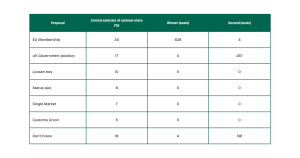
EU membership was the most popular EU relations policy in all but four parliamentary seats in Great Britain.
In the remaining four seats, Ashfield, Clacton, Great Yarmouth and Boston and Skegness, ‘Don’t Know’ was the most popular answer.
In 57% of constituencies, ‘Don’t Know’ was the second most popular answer, while in 42% of constituencies the second most popular answer was the UK Government’s current position of seeking a closer relationship with the EU, within its red lines.
As the vote share data indicated, EU membership is the most popular option in every region and nation of the UK. It won in all but four parliamentary seats. In 84 seats, it was more popular than all other options combined.
By region, support was especially high in Scotland, London and inner-city areas. By party, support is highest in seats won by the SNP, Greens, and Liberal Democrats in 2024.
The results in this report showed that, when it comes to EU relations, there was significant unity of purpose among the entire left of British politics. Sizeable majorities of current Labour, Liberal Democrat and Green Supporters – which are almost entirely composed of former ‘remain’ voters at the 2016 referendum – were again found to most want the UK Government to propose EU membership.
Together with Labour’s voters who have switched to support the Green Party, they drove EU membership to be the most popular policy proposal in all-but-four constituencies in Great Britain, in every nation and region of Great Britain, and in the Prime Minister’s own seat.
Methodology
YouGov surveyed 11,927 people. The survey was carried out between 27th May – 11th June 2026.
The survey was conducted using an online interview of members of the YouGov Plc GB panel of 400,000+ individuals who have agreed to take part in surveys. An email was sent to panellists selected at random from the base sample according to the sample definition, inviting them to take part in the survey and providing a link to the survey.
The samples were weighted to the profile of the sample definition to provide a representative reporting sample. The profile is normally derived from census data or, if not available from the census, from industry accepted data.
For the question presented to respondents, YouGov carried out a MRP (multilevel regression and post-stratification) analysis. Results were projected across all constituencies in Great Britain, with each multilevel model run with 3,000 iterations across seven monte-carlo Markov chains.
The full MRP model process took information gleaned from estimating a multilevel model between question response and respondent and area background and characteristics, and projected these findings on to all 632 British 2024 Westminster Parliamentary constituencies.
Sign up for our newsletter
Get our research, campaigns, and analysis in your inbox. No spin, no noise — just the evidence-led case for a better Britain.